How Will New Developments in Birmingham Affect The Property Market?
Birmingham is the UK’s largest city outside London, with a population of 1,183,618 in 2024 (ONS), and it needs more homes. The city added around 10 new homes for every 1,000 existing dwellings in 2024–25 (ONS), which is not enough to keep pace with demand. That shortfall is one reason average rents in Birmingham rose 3.3% in the year to September 2026, to £1,106 a month.
Regeneration helps in two ways. It adds new homes, and it makes the areas around each scheme more attractive places to live, through new jobs, transport links, shops and public spaces. Historically, that has supported both rents and prices in the surrounding postcodes, and average sold prices in Birmingham have risen 48.2% over the past ten years, as per HM Land Registry.
The outlook is positive too: after a flat 2026, Savills forecasts house prices in the West Midlands to rise by 3.0% in 2027 and 19.7% over the five years to 2030, whereas our own forecast for Birmingham is 3.0% to 5.0% growth in 2027.
Birmingham Smithfield
Birmingham Smithfield is one of the biggest city-centre regeneration projects in the UK. Historically the site of Peter de Birmingham’s 12th-century moated manor (a Scheduled Monument) and later 19th-century Smithfield livestock and wholesale markets, the area most recently hosted events like 3×3 basketball and beach volleyball during the 2022 Commonwealth Games.
The £1.9bn to £2bn scheme will transform 17 hectares on the former wholesale markets site next to the Bullring into a new neighbourhood with thousands of homes, a large public square, revived Bull Ring Markets, workspace and leisure, linking the city centre to Digbeth. The regeneration scheme is designed as a zero-carbon urban quarter prioritising pedestrians, cyclists, and high BREEAM/WELL Building standards
While Smithfield will change the area significantly, it is designed to build on Digbeth’s developing creative character rather than replace it. Often described as Birmingham’s answer to Camden, Digbeth is known for its street art, independent venues and food markets, and the new development will bring more homes and jobs to an area that is already popular with young professionals.
Featured Development
No. 30 St Pauls
Birmingham
Introducing No. 30 St Pauls, 58 luxury apartments in Birmingham’s sought-after Jewellery Quarter.
- 1, 2, and 3 bedroom luxury apartments
- Rental values to increase by 18.8% over the next 5 years (JLL)
- Property values to increase by 24% over the next 5 years (JLL)
- 20 % Deposit required
- Estimated completion Q1 2026
- Prime location directly on St Paul’s Square
Prices From
£249,950
Paradise
Paradise Birmingham is transforming the city’s civic heart, blending heritage with modern design to create a vibrant hub for business, leisure, and urban living. With a £1.2 billion investment, the development is attracting businesses, talent, and visitors while enhancing the city’s skyline.
The second phase is progressing rapidly, following the completion of the 280,000 sq. ft. One Centenary Way in 2023. The striking Octagon residential tower and the 189,000 sq. ft. office building, Three Chamberlain Square, have recently been completed. By 2028, Paradise will be a thriving destination, offering contemporary office space, high-quality buildings, and dynamic public spaces.
As the project nears completion, it will introduce a range of new amenities, including premium restaurants, stylish bars, and a luxury hotel. Set within Birmingham’s expanding business district, Paradise is not just a Birmingham redevelopment scheme: it is a catalyst for the city’s future growth, creating a world-class environment for working, living, and socialising.
Curzon Street Station
The HS2 development at Birmingham’s Curzon Street Station is set to drive significant regeneration in the region. As part of Britain’s new high-speed rail network, the station will drastically cut journey times between London and Birmingham to just 49 minutes, with connections extending to major cities like Manchester, Liverpool, and Glasgow. This marks the first new intercity terminus to be built in Britain since the 19th century, with a commitment to achieving net-zero operations.
The project is expected to create over 1,000 jobs during its main works phase, alongside an £816 million boost to local companies, almost doubling the economic impact of the Commonwealth Games. Birmingham City Council has committed £724 million to regeneration through its Curzon Investment Plan. Over the next three decades, this transformative scheme will deliver up to 4,000 new homes, 36,000 jobs, and several new neighbourhoods across 150 hectares, positioning the city as a dynamic hub for business, transport, and sustainable living.
New Square Garden
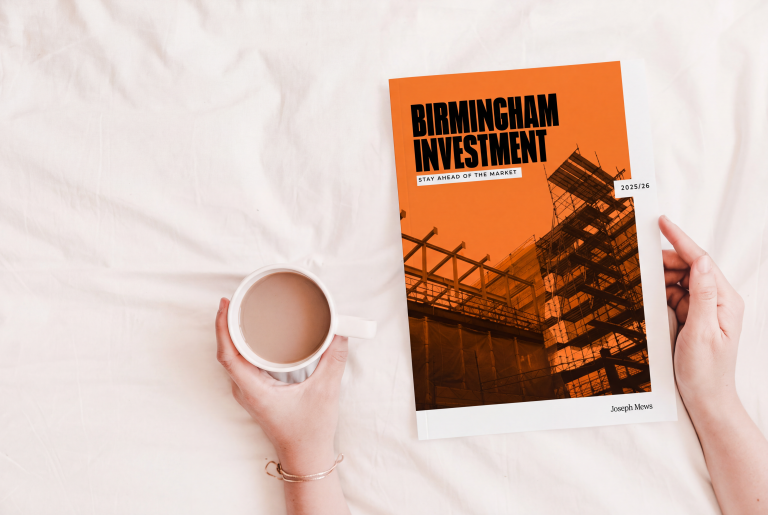
Want to know more about the Birmingham property market? Download the Birmingham Investment Guide today and discover everything you need to know about Birmingham property investment in 2027 and beyond. In this guide, you’ll find:
- Current market performance
- Forecasts for the Birmingham property market
- Key trends impacting the market
- Best places to invest in Birmingham
West Midlands Metro Extensions
Other Developments In Birmingham
Although we’ve listed some of the most significant new developments in Birmingham for 2026 and beyond, this is far from an exhaustive list. Additional Birmingham developments projects underway include…
Better transport is a key part of Birmingham’s regeneration. The West Midlands Metro has already been extended through the city centre to Centenary Square, Brindleyplace, Five Ways and Edgbaston, and further extensions are planned or under way across the region:
- Eastside extension: taking the Metro from Bull Street through Eastside and Digbeth, serving Curzon Street station.
- Wednesbury to Brierley Hill: a new line across the Black Country, connecting Dudley and Brierley Hill to the wider network.
Ladywood Regeneration
Ladywood, just west of the city centre, is the focus of a £2.5bn long-term regeneration programme. The plans include up to 12,000 new homes – with at least 20% of these being affordable homes – along with new parks, schools and community facilities, replacing ageing estates with a new, mixed neighbourhood a short walk from Brindleyplace and the Jewellery Quarter. If delivered at that scale, Ladywood would be one of the largest housing-led regeneration projects in the country, generating approximately 41,000 jobs and 1,000 apprenticeships. Construction is due to begin in 2028
Birmingham Enterprise Zone
The former flagship John Lewis store within Grand Central Station is set to be repurposed into The Drum, a mixed-use development. With office spaces, a gym, eateries, a roof garden and events space, it is set to become an iconic Birmingham new development.
Typhoo Wharf
Set to become the new home of the BBC, the former Typhoo Tea factory will see the BBC relocate from its current Mailbox headquarters. The Digbeth-based former factory will become a hub for creativity not just in Birmingham, but across the UK, and is set to open in time for 2027.
Beorma Quarter
This upcoming mixed-use project in Digbeth is set to bring commercial office spaces, homes, and even a hotel to the city core, scheduled for completion in 2026. Spanning 93,000 square metres, the £200 million Beorma Quarter project will sit adjacent to the Bullring, offering optimal convenience for residents and businesses alike.
New Build Homes in Birmingham
Most new homes in Birmingham city centre are apartments, with many being delivered as build-to-rent schemes, where one landlord owns and manages the whole building, or as apartments sold to owner-occupiers and investors. Larger regeneration schemes such as Smithfield and Ladywood will add thousands more homes over the next decade, while new houses are mainly being built on the edges of the city.
New Build Apartments in Birmingham
Apartments are the most popular choice for buy-to-let investors in Birmingham. The average flat in the city costs £144,000 and rents for £923 a month, a gross yield of 7.7% according to the ONS. Those averages include older stock, so it’s worth noting that new-build apartments usually cost more to buy, but they typically achieve higher rents and appeal to the young professionals who make up the largest group of renters in the city centre.
New builds also have practical advantages for landlords:
Energy efficiency. New homes already meet the EPC C standard that rented homes are expected to need by 2030, which JLL expects to push rents higher as older properties leave the market.
Lower maintenance. Modern buildings need fewer repairs in their early years, and most come with a structural warranty.
Tenant appeal. Modern specifications and on-site amenities help attract tenants quickly and reduce empty periods.
Buying Off-Plan Property in Birmingham
Many new developments in Birmingham sell apartments off-plan, before construction is complete. Buying off-plan can give investors access to launch prices, a choice of units and time to arrange finance before completion. It also carries risks, such as construction delays and changes in the market before completion, so it is important to check the developer’s track record and the terms of the contract carefully.
FAQs About New Developments in Birmingham
What do new developments mean for investors?
Buying near major regeneration can give investors two sources of return: rising rents as the area improves, and capital growth as more people want to live there. The key is choosing schemes that are funded and under way, rather than proposals that may change or be delayed.
In Birmingham, the areas around Smithfield and Curzon Street (Digbeth and Eastside), the Jewellery Quarter and Ladywood are well placed to benefit from regeneration over the next decade. Find out more in our guides to the best rental yields in Birmingham and the best places to live in Birmingham.
What new developments are planned in Birmingham?
Major new developments in Birmingham include Birmingham Smithfield, Paradise, HS2’s Curzon Street station and the surrounding Curzon Investment Plan, the Ladywood regeneration, New Garden Square in Edgbaston, the BBC’s move to Typhoo Wharf in Digbeth and further extensions to the West Midlands Metro.
What is the biggest regeneration project in Birmingham?
By value, the largest are the £2.5bn Ladywood regeneration, with up to 12,000 homes planned, and the £1.9bn to £2bn Birmingham Smithfield scheme. HS2 and the regeneration around Curzon Street station will also reshape the east of the city centre over the coming decades.
Where are new homes being built in Birmingham?
Most new apartments are being built in and around the city centre, including the Jewellery Quarter, Digbeth, Eastside and Edgbaston. Larger housing-led schemes are planned at Smithfield and Ladywood, while new houses are mainly being built on the edges of the city.
Are new build homes a good investment in Birmingham?
New build apartments can be a strong investment in Birmingham, thanks to high tenant demand, rents that rose 3.3% in the year to September 2026 and a forecast price recovery from 2027. They cost more than older flats, so yields are usually lower than the 7.7% average for all flats, but they tend to let quickly, need less maintenance and already meet the energy-efficiency standards landlords will need by 2030.